SignalScope
SignalScope collects answers from AI platforms and keeps a record of how a business appears in them. The application accepts a business and a set of prompts, collects the responses, runs a separate analysis and saves a report. The saved result preserves both the original answers and the analysis available at that time.
The question behind the application is simple enough: if somebody asks an AI service for a business like yours, what answer do they get? Making that answer useful over time introduces several more questions. Was the prompt the same? Did every platform return a result? Has the response actually been reviewed? Can somebody open the source answer and check the conclusion?
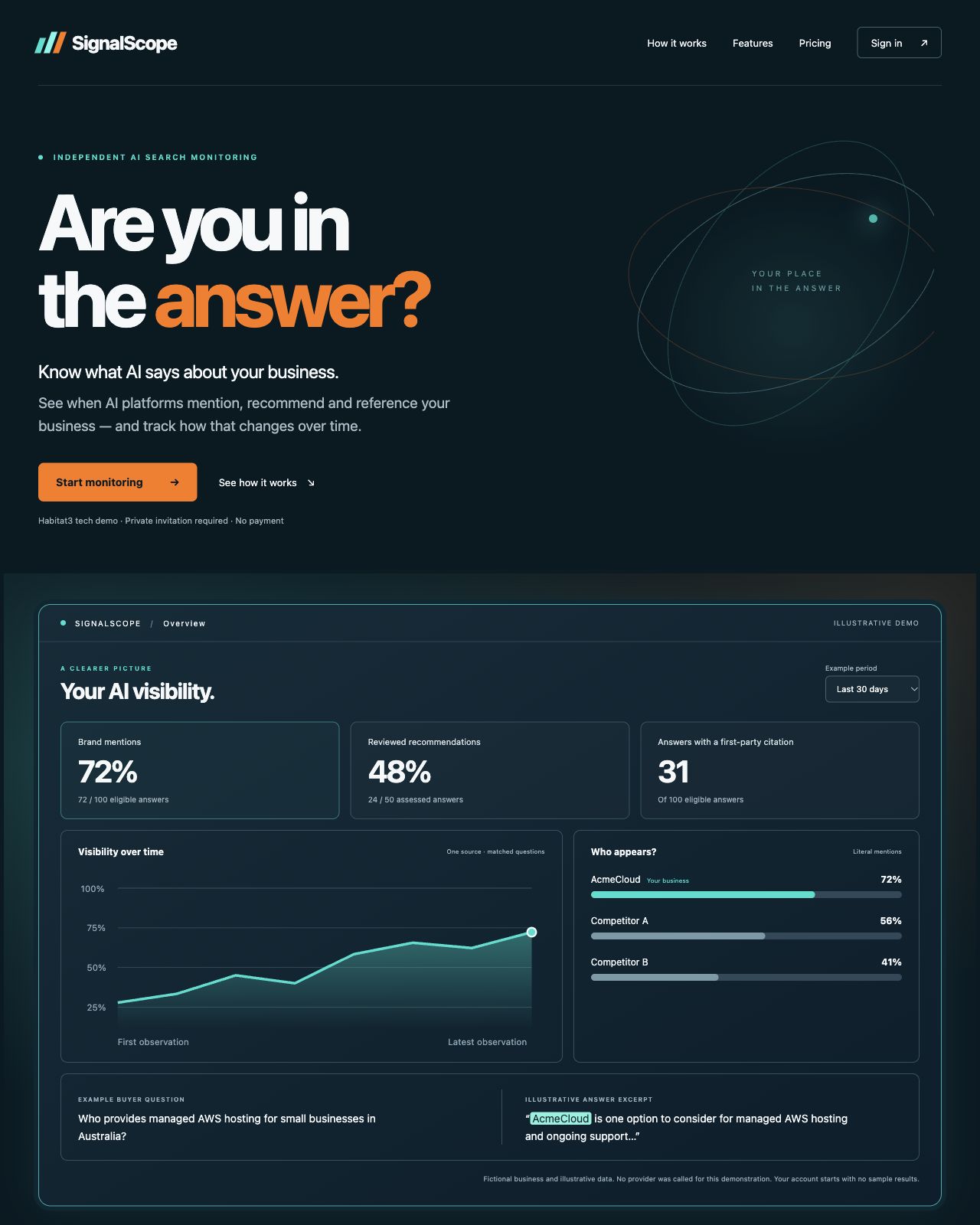
A report needs an answer behind it
The report interface brings together platform results, a visibility timeline and a prompt-by-date comparison. A result can be opened to inspect its full response. Prompts retain their complete wording. Saved runs for the same business can build a history, and the report can be filtered by period or platform.
One of the more important details is how missing data is treated. A failed collection is not evidence that a business was absent from an answer. An unreviewed answer is not yet an assessed result. Those states remain separate rather than being collapsed into a negative score.
Comparisons also depend on matching questions. If the wording of a prompt changes, it appears as a separate row. Trend percentages use reviewed replies to exactly matching prompts, and incomplete points are marked. A single saved run is the first benchmark; it does not establish a trend by itself.
The application behind the page
The hosted project uses a Vercel frontend and a Supabase backend, with workspace membership and row-level security around private data. Bright Data collects platform responses, and OpenRouter supplies a separate review step. Collection and review can complete or fail independently, so the interface needs to reflect what has actually happened to each response.
Keeping provider keys server-side, preserving saved reports, and separating workspaces are all part of making the application usable beyond a demonstration. The source project also includes report reopening, password recovery and an invitation-only sign-up flow. The current hosted version is a limited pilot.
This project has been an exercise in resisting the temptation to make a summary look more certain than its inputs. A percentage is only useful when the reader can tell what was collected, what was reviewed, and which questions it represents.
SignalScope website. Access to the application is by invitation.